

Extended ISPyB (EXI) (Now available with limited features))
- Logging in to EXI
- Create a shipment
- Create new samples and provide a sample list
- Send the shipment to DESY
- Arrange the return of dewar(s)
EXI can be used for creating a shipment to and from P11. After shipment creation, the sample information can be uploaded as a csv-file for synchronization with MXCuBE during beamtime. Note: Even if you are using your own shipping labels, or bringing the dewar to DESY yourself, the ID label helps to identify the dewars and shipment creation is necessary for the sample information upload.
Logging in to EXI
Users with Door credentials can log in to EXI and create shipments for their already scheduled P11 experiments.
- Go to the DESY EXI website (https://exi.desy.de/exi/mx/#/welcome ).
- Log in with your DOOR account credentials.
- In Home/Sessions tab, select the period of time for the experiments you'd like to view (Fig. 1). List of your upcoming beamtimes appear. Click on the proposal identifier to specify which proposal you'd like to work with. Please note that if you are not the proposer or co-proposer and the participant list of the beamtime has not been filled in yet by the PI, you might not see the beamtime in Door.
- If your proposal is not listed and you need help, please contact the beamline staff with p11beamline@desy.de
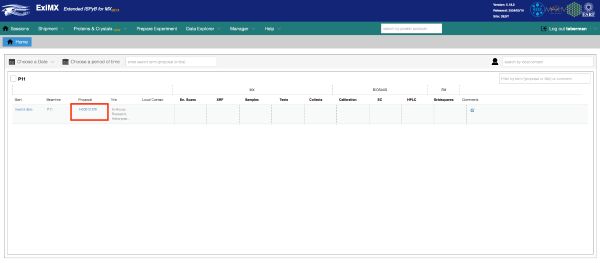
Figure 1.
Create a shipment
In the shipment tab you can manage the shipping addresses and modify the shipping address card. Please do check that the information given here is correct. To create a shipment:
- From the Shipment drop down menu, select Shipments and Add new (Fig. 2).
- Fill in the shipment form.
- The name field entry will appear in the list of created shipments and the ID labels. Names useful for your own archiving purpose are recommended.
- The session dropdown menu connects the shipment to a specific beamtime.
- Select from the From drop down the name of your shipping address card and verify that information in it is correct. This can be seen in Shipment tab/Manage Shipping Addresses.
- Add to Comments any additional information e.g. if you will transport the dewar yourself, or the tracking code for already booked transports.
- Specify the return address and Save the entered information.
- If you wish to view or edit the information after saving the form, select List under Shipments in the Shipment dropdown menu. That will show a list of your shipments in the left side of the window in inverse order of creation (you might need to refresh the page to show the newly created shipment). Clicking on specific shipment in the list will open the shipment information.
- Add the contents of the shipment as explained in the following section
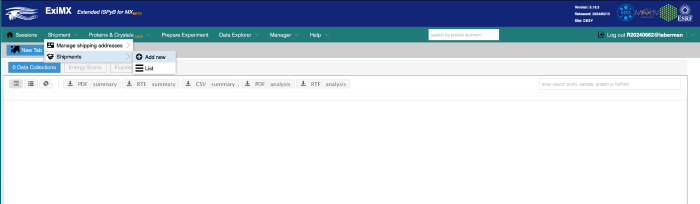
Figure 2.
Create new samples and provide a sample list
This section describes how to enter information about the parcels, containers and samples present in the shipment. Adding the parcels must be done in order to generate the shipping label for the dewars, as described in the Send shipment section in this document. However, filling up the sample details can be done while the dewars are in transit or even when they are already at DESY. Once the Unipucks are loaded in the sample changer dewar (shipment status set to “processing”) it will not be possible to change the shipment contents any longer.
Creating a new sample
If you are sending crystals of a new protein, it is important that you create an entry for the protein, since you will not be able to upload or save information from an unknown sample. To create a protein follow these steps:
- Click on Proteins and Crystals in the upper menu bar (Fig. 3).
- Select Add new protein. You can also display the List to check is the protein is already present.
- Enter the protein name and acronym and click Save. The name is merely descriptive and will not be used by the software.
- If you wish to enter and save the space group and unit cell, look for the protein in the list and click on the Crystal form tab at the right of the card. This information is not compulsory and can also be added at a later stage for each crystal in the sample information list.
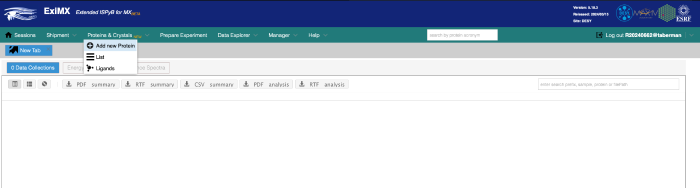
Figure 3.
Fill the sample information in a CSV file
- To add containers and sample information go back to your shipment by selecting List in the Shipment dropdown menu. That will show a list of your shipments in the left side of the window in inverse order of creation (you might need to refresh the page to show the newly created shipment). Click anywhere on the shipment card to open the shipment information.
- A practical way to enter information about the parcels, containers and samples included in the shipment is by uploading a CSV file.
- The upload menu is accessed by clicking the Import from CSV button in the shipment card (Fig. 4). The example file below will generate a parcel called Dewar1 containing seven Unipucks fully loaded with crystals of different proteins.
- After saving the sample list, you can edit the information by going to the shipment page, clicking on the containers and selecting Edit. That will display the sample list for that container. You can also make corrections to the CSV file, then delete the parcel by clicking on the “Edit” icon to the right of the parcel pane and clicking on Remove, and finally reload the corrected CSV again.
- You can now find the filled up parcel in the shipment page. Use the icons to the right to add extra Unipucks, edit/remove the parcel, print the shipping labels. To import a CSV file, use the link above the parcel pane.
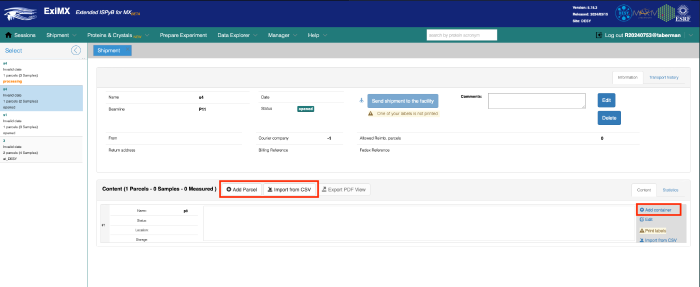
Figure 4.
Fill the sample information online
- To add containers and sample information go back to your shipment by selecting List in the Shipment dropdown menu. That will show a list of your shipments in the left side of the window in inverse order of creation (you might need to refresh the page to show the newly created shipment). Click anywhere on the shipment card to open the shipment information.
- Click the Add parcel button (Fig. 4).
- Fill up the parcel name (must be unique within the shipment) and select the type (usually “dry shipper”). Then, click Save.
- Back at the shipment page, click on the Add container link to the right of the new parcel card (Fig. 4).
- Enter the name of the container. This must be the name engraved in the Unipuck, and it must be unique within the shipment. Then select Unipuck as the type; this is the only type of container supported at P11. When you save, an image of the Unipuck will be displayed in the parcel card (Fig. 5).
- Click on the Unipuck and select Edit This will direct to the spreadsheet form where you can list the samples in the container (Fig. 6).
- Select the protein from the drop down menu. If it is not there, create a new sample as either from the Proteins and Crystals menu as described above or by clicking on the Add Protein button in the container sample list spreadsheet form.
- Enter a sample name. It must be unique for each sample of each protein.
- After filling up the sample information, click on Shipment button above the spreadsheet and reply Yes to save the changes to the container.
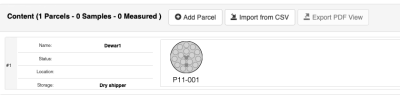
Figure 5.
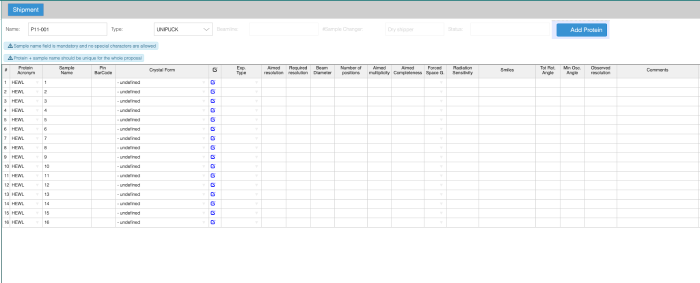
Figure 6.
Send the shipment to DESY
- Click on the Print labels icon (Fig. 7) to the right of each parcel to generate a PDF file with the shipping and return EXI labels. Make sure that the information on the labels is correct. If not, go to the “Shipping addresses” list and correct the information.
- If everything is correct, print the labels. Please attach the dewar label and the shipping label on your dewars, and enclose the return label within the dewar box with other return forms (courier waybill or invoice).
- If you are sending to and from outside EU and need customs declarations:
- You need to fill in a Proforma invoice to send along with the shipment.
- Be sure to use a proper description of the content of the shipment, as an example: “Dry shipper containing small frozen protein crystals for scientific experiments. Crystals are non-hazardous. Dewar contains non-flammable gas (liquid N2).”
- The button Send Shipment to the facility (Fig. 7) will activate once you print the labels (you might need to update the page for this). When you click it, the status of the dewar will change to “Mark shipment at facility”. This will let beamline staff know that the shipment is on its way.
- When the dewar arrives at DESY, staff will click the button again and the shipment status will be set to “Send shipment to the user” to wait for the return transport.
- You will be able to modify the shipment in EXI after shipping the dewars until your pucks are inserted in the sample changer dewar.
- After your dewar has arrived to DESY and it is the time for your experiment the local contact will insert the pucks in the sample changer dewar and assign the actual Unipuck position in to the Prepare experiment tab for synching the information to MXCuBE.
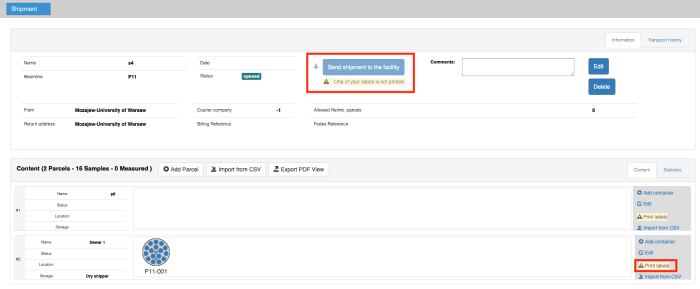
Figure 7.
Arrange the return of dewar(s)
- You are responsible for organizing the courier for the transport of both incoming and departing dewars.
- Please be prepared to order the return shipment before the beamtime, and be sure to attach the return papers from your courier to the dewar in addition to the EXI-generated shipping labels
- If the courier will not supply you with a return waybill at the moment you ship the dewar, please send an email to p11beamline@desy.de to arrange this after your beamtime and to send the labels from your courier.
- After the data collection is done, local users should do the following:
- Attach the return address papers from your courier and the paper from EXI to the dewar(s)
- Put the dewar in the designated area outside P11 (“Dewar departure point”).
- Please be aware that you need to order the courier yourself and please check that the return address is complete.
- Inform the expected pick-up date and time to the p11beamline@desy.de address at least a day in advance.
- If you are sending to and from outside EU please enclose the Proforma invoice.